Coastal Resilience Practitioner Training: Modules
Overview of Modules
The 8 modules of the online course offered in 2026 for U.S. practitioners are 4 hours each to fit demanding professional schedules. The curriculum is iterative and adaptive, with each module building on the last. Each module will be taught by an expert on the topic, with engaging and interactive formats featuring guest speakers, short presentations, case studies, hands-on exercises, and small-group discussions. Trainer bios are at this link.
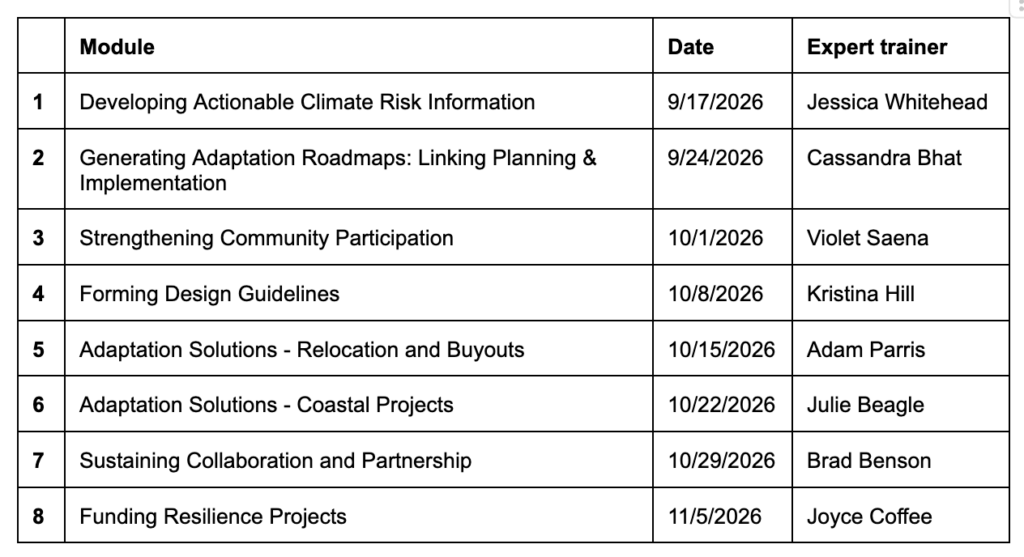
Module Descriptions
Module 1: Developing Actionable Climate Risk Information
This module will provide practitioners with tools to interpret the vast array of sea level rise projections available to select the most appropriate ones for their context and planning process. Practitioners will be able to evaluate multiple lines of evidence contributing to sea level rise projections and how the evidence base results in probability, likelihood, and expert confidence in the IPCC and other influential national and regional assessments. This module will cover contemporary methods for science translation, risk communication, and coastal risk and vulnerability assessment. A central, cross-cutting topic will be the importance of frequent and iterative dialogue with scientists, decision-makers, and community-based and non-profit organizations as climate science evolves.
Primary Learning Objectives
- Understand actionable climate information addressing risk and vulnerability analysis in coastal areas.
- Interpret and use a range of sea level rise projections from low likelihood/high consequence to high likelihood/low consequence futures, including most likely projections in the middle).
- Apply sea level rise projections in coastal risk and vulnerability analysis.
- Distinguish between various SLR and flood mapping tools.
Practitioners will also gain knowledge on:
- Climate service providers in academia and the private sector. .
- Sources of uncertainty and how they change over time.
- Frameworks for assessing vetted and novel science outputs.
- Methodologies, advantages and limitations of probabilistic projections .
- Emerging science on compounding and multi-hazard risk analysis, including rising groundwater levels.
Module 2: Generating Adaptation Roadmaps: Linking Planning and Implementation
This module will focus on emerging practices to link planning and implementation efforts using practical tools to account for evolving future climate projections and conditions. Because long-term projections cover a broad range of potential futures, tools to facilitate planning, minimize maladaptation risk, and right-size investments are essential. Participants will come away with an understanding of the similarities and differences between various approaches to adaptive planning (e.g., decision-making under deep uncertainty, scenario planning, dynamic adaptation pathways, adaptive management) and how to select the best approach for their community or agency.
Primary Learning Objectives
- Understand how to apply scenario planning and adaptation pathways.
- Identify potential climate tipping points, using signposts and monitoring systems, that trigger timely implementation of adaptation actions.
- Develop roadmaps to overcome institutional, financial, and social barriers to adaptation.
Practitioners will also gain knowledge on:
- Adaptive climate risk management frameworks like robust decision-making and scenario planning
Module 3: Strengthening Community Participation
Strong community participation and leadership is crucial for just, equitable, and democratic adaptation processes. The climate adaptation community is making great strides in using tools and techniques for community and civic engagement, from participatory research and coproduction of knowledge to trauma-informed approaches to forming alliances with underserved communities of color and tribes. These approaches empower communities to be active partners in designing adaptation solutions that are tailored to community needs as well as to build trust, political will, and long-term adaptive capacity. This module will focus on multi-modal engagement along the spectrum of approaches leading to stronger public and community participation in coastal adaptation.
Primary Learning Objectives
- Apply diverse strategies for community engagement to navigate dynamic public trust in science.
- Design and facilitate participatory solutions, blending local and traditional knowledge with scientific data.
- Gain experience with translation of scientific, engineering, and planning information to community engagement processes.
Practitioners will also gain knowledge on:
- Root causes, legacy injustice, and factors that inhibit strong community engagement.
- Translation of scientific, engineering, and planning information to community engagement processes.
Module 4: Resilient Design and Engineering
Coastal zones are home to complex, interwoven infrastructure that support local to international communities, ecosystems, and economies. Among other things, ports, highways, parks, substations, and wastewater treatment plants all intersect at the coast. Increasingly, coastal cities and states are using design guidelines and standards to ensure robust, forward-thinking, and systems-based design supports resilient coastal zones. This module will equip practitioners with practical skills and knowledge to encourage, incentivize, and enforce climate resilient design.
Primary Learning Objectives
- Integrate climate risk information, including future climate projections and concepts of non-stationarity, into design standards and building codes for infrastructure and related systems.
- Apply principles of adaptive and resilient design and systems thinking in infrastructure planning and implementation.
Practitioners will also gain knowledge on:
- Specialized design considerations and strategies for protecting unique assets (e.g. historic structures and critical infrastructure), retrofitting existing structures, and incentivizing resilient design on private property.
- ASCE and ACE standards for professionally compliant, climate-informed design choices.
Module 5: Adaptation Solutions – Relocation and Buyouts
Rising insurance costs and repetitive losses are just two signs that some coastal areas will be too risky to develop or inhabit. Cities and states are already experimenting with de-densifying developed areas through buy-outs and with relocating infrastructure. These issues touch on historic legacies of redlining and rampant coastal infill giving rise to questions of justice, governance and affordability. This module covers ways to build community resilience and collaborative governance in support of sustainable development as well as legal, regulatory, and zoning frameworks associated with relocation and buy-outs. It will equip practitioners with knowledge and resources to foster systemic change while building and sustaining adaptive capacity over time.
Primary Learning Objectives
- Apply concepts of collaborative governance to promote community-centered adaptation.
- Understand complex real estate issues and strategies such as zoning, building code updates, and property buy-out programs.
Practitioners will also gain knowledge on:
- The history of relocation and buyout programs in the United States and lessons learned for future coastal efforts
- Feasibility and implications of non-structural initiatives like retreat and relocation, including what happens to the land.
Module 6: Adaptation Solutions – Coastal Projects
The accelerating pace of sea level rise necessitates coastal adaptation projects that reduce flood risk while balancing coastal habitat, infrastructure, and community needs. These solutions must address immediate, near- and long-term risks, account for uncertainty, and recognize fiscal, socio-political, and geographic constraints. This module will provide a comprehensive overview of the diverse strategies available at the project scale to maintain shoreline and community resilience, from traditional hardened defenses to nature-based solutions and hybrid green-gray approaches.
Primary Learning Objectives
- Choose from a wide range of solutions, from traditional engineering approaches to shoreline management to nature-based approaches, based on the surrounding coastal habitat, infrastructure, and community needs.
- Optimize addressing risks across critical systems of significance (e.g., drinking water intakes, CSOs, utilities).
- Navigate federal, state and local regulations and permitting processes.
Practitioners will also gain knowledge on:
- Long-term maintenance and life-cycle costs associated with various solutions to ensure financial viability and sustainability.
- Real-estate considerations (e.g., when do you consider acquisition of an easement or fee interest for implementation? What are the implications for timeline, liability, etc.?)
- Monitoring and evaluation frameworks to improve adaptive management of resilience projects over time.
Module 7: Sustaining Collaboration and Partnership
Successful adaptation requires strong collaboration and strategic partnerships within and across all levels of government and between governmental and non-governmental organizations. The module will explore models of collaborative governance that enable multi-jurisdictional cooperation and regional collaboration which are essential for managing shared coastal resources and interconnected infrastructure. A primer will be included describing collaboration opportunities between local governments and the US Army Corps of Engineers, a potentially advantageous federal partner for some jurisdictions planning for long term and costly adaptation action.
Primary Learning Objectives
- Work with the USACE, HUD, and other federal agencies
- Balance regional to local authority; collaborating across jurisdictional boundaries.
Practitioners will also gain knowledge on:
- Regional collaboration
- Public and private partnerships
Module 8: Funding Resilience Projects
Securing adequate funding is essential for building resilience in the face of increased risks from severe weather, sea-level rise, and variable water availability. This module will provide practitioners with practical guidance on navigating the complex landscape of resilience funding, from leveraging traditional public funding sources to exploring innovative private investment opportunities and blended financing models. Highlighting both successes and challenges, this module will spotlight creative approaches that diverse actors are leveraging to bridge resource gaps and take control of their resilience funding needs.
Primary Learning Objectives
- Understand and leverage a wide array of funding sources and financing mechanisms and how to combine them.
- Articulate the business case for resilience initiatives by quantifying benefits and assessing the cost of inaction.
- Ensure sufficient funding for both investment in and operation and maintenance of new resilience projects.
Practitioners will also gain knowledge on:
- Insurance solutions
- Valuing natural capital (as part of making the business case)
ACKNOWLEDGEMENTS: This training was designed by a Curriculum Advisory Committee composed of professionals with extensive experience in coastal climate adaptation. We are incredibly grateful for their in-kind contribution of time, expertise, and wisdom.
- Lisa Auermuller – Rutgers University
- Bilal Ayyub – University of Maryland
- David Behar (Chair) – San Francisco Public Utilities Commission
- Brad Benson – Port of San Francisco
- Lara Whiteley Binder – King County
- CJ Bodnar – City of Portsmouth, Virginia
- Alan Cohn – City of New York
- Katherine Hagemann – City of San Rafael
- Jack Liebster – Retired (Marin County)
- Glynis Lough – PEERS
- Jayantha Obeysekera – Florida International University
- Chris Osgood – City of Boston
- Abby Sullivan – City of Philadelphia
- Jessica Whitehead – Old Dominion University
- Tiffany Wise-West – City of Santa Cruz
We wish to acknowledge generous support from the NOAA Adaptation Science program and the Water Utility Climate Alliance. Staff support was provided by Adam Parris, Cassie Bhat, and Sneha Balakrishnan from ICF.
